LLMs are stateless – It Forgets Everything Unless You Build Around It
Large Language Models are stateless — they forget everything between interactions. That’s why real business value doesn’t come from the model itself, but from the engineering system built around it. The illusion of intelligence depends entirely on how well you design, orchestrate, and scale that context.
I’ve lost count of how many conversations I’ve had over the past year that began with the same hopeful question:
“GenAI can just do everything, right?”
It’s a fair assumption. If your exposure has been limited to ChatGPT or polished demos, it really does look like magic. The model talks fluently, answers questions quickly, and seems to remember what you said.
But having led multiple GenAI implementations inside large enterprises, I can tell you: it’s not magic. And it doesn’t “just work.”
Behind every smooth, intelligent GenAI experience lies a great deal of invisible effort — the kind of engineering most people never see.
At the core of every large language model is a simple but often overlooked truth:
LLMs are stateless.
That means the model does not retain memory of past interactions. It has no awareness of prior conversations. Each time you send a prompt, the model predicts the next words — based solely on that single prompt and whatever context you include with it.
When a GenAI assistant feels helpful, coherent, or personalized, it’s not because the model is intelligent on its own — it’s because the application layer is doing the heavy lifting.
Here’s what that actually involves in practice:
- Keeping a running history of the conversation: So the assistant can “remember” what was just said — otherwise, it would treat each message as if it were the first.
- Injecting relevant business data in real time: For example, showing the right customer profile or policy detail — so answers are tailored and accurate, not generic.
- Designing prompt orchestration logic to manage the model’s limited memory window: The model can only handle so much information at once — like a short-term memory buffer — so we have to decide what stays in and what gets left out.
- Implementing memory strategies across sessions: This lets the assistant pick up where the conversation left off — like knowing you already asked for a quote yesterday, or remembering your preferences.
- Enforcing security and privacy guardrails: Making sure sensitive data — like internal documents or customer records — is protected, and nothing is accidentally exposed or leaked to the model.
- Filtering irrelevant or outdated information: Just because something was mentioned earlier doesn’t mean it’s still useful — we need logic to keep the conversation focused and on-topic.
Each of these elements requires thoughtful engineering. Not just to make the chatbot sound intelligent — but to make sure it is reliable, secure, and genuinely useful in a business setting.
Statelessness may sound like a technical detail, but it defines everything about how these systems behave. It’s why GenAI isn’t plug-and-play, and why simply accessing a powerful model doesn’t guarantee results.
This is where most misconceptions begin.
The model is often mistaken for the product. But in reality, what makes a GenAI application useful isn’t the model itself — it’s the system wrapped around it: the context handling, memory strategies, interfaces, guardrails, and integrations.
The model is just the starting point. The real value lies in how you build around it.
Key Takeaways
- LLMs are stateless by nature. They do not retain memory — context must be engineered into the system for continuity and coherence.
- The model is not the product. Real business value comes from the system you build around the model: context management, memory, integration, and governance.
- GenAI is not plug-and-play. Success depends on thoughtful design and enterprise-grade engineering — not just model access.
- Same model, different results. Two companies using the same foundation model can deliver completely different experiences based on system design.
- Strategic advantage lies in the orchestration. The intelligence your users experience is a reflection of how well you’ve designed the system around the model.
Continue Reading
See more
GenAI and the Changing Value of Human Talent
Last week was packed with meaningful events, but one that I hold closely is the opportunity to contribute to the…
Mar 4, 2026
Get to know Generative AI in-depth insight
Generative AI (Artificial Intelligence) is a category of technology developed to automatically generate new data and content from existing information, ...
Mar 4, 2026
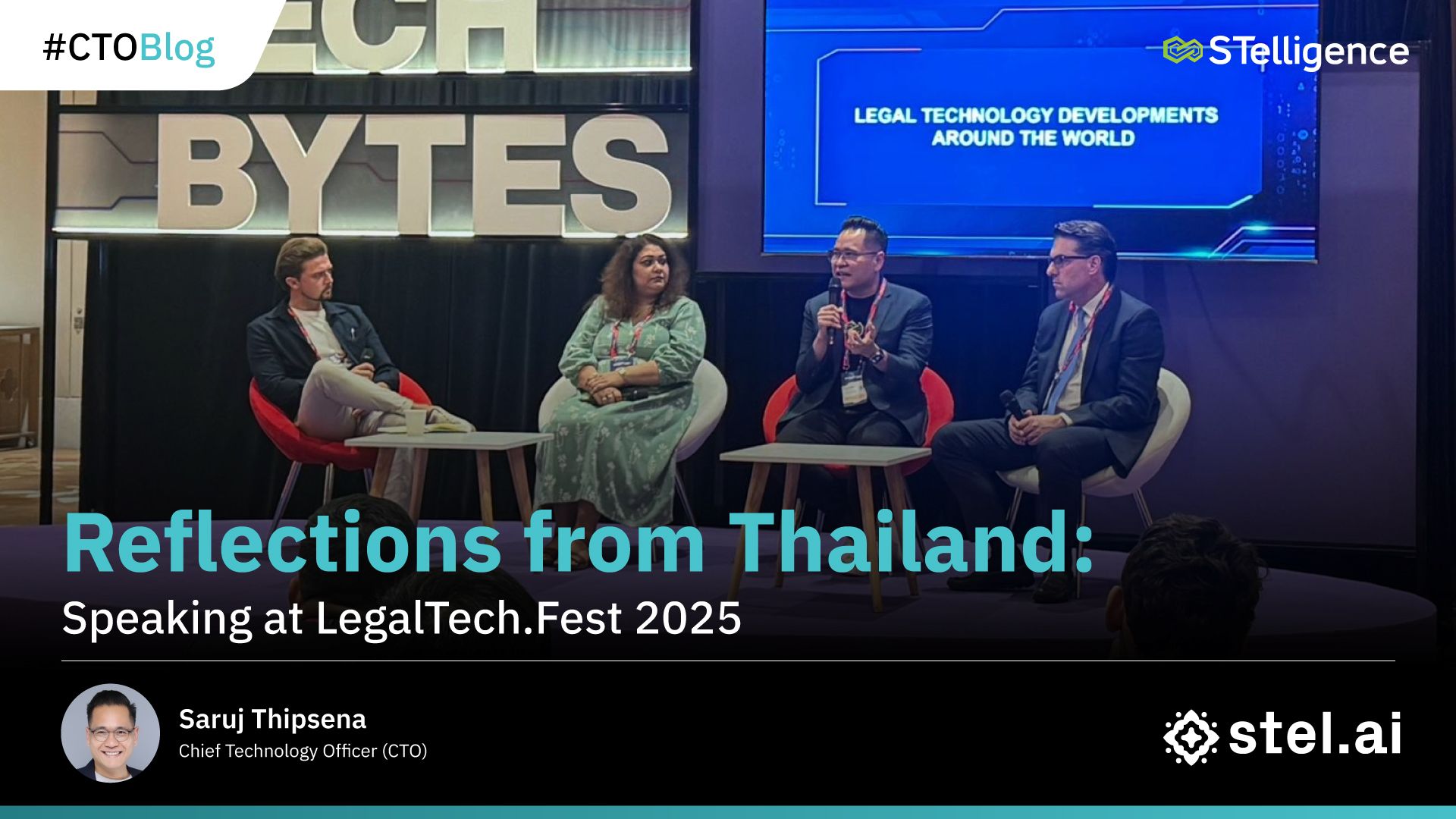
Reflections from Thailand: Speaking at LegalTechFest 2025
Last week, I had the honour of speaking at LegalTechFest 2025 in Singapore...
Mar 4, 2026